

Strategic Fabrication for Cross-Country Pipelines
The United Arab Emirates is crisscrossed by a vast network of steel arteries. These pipelines are the lifeblood of the nation's economy, transporting crude oil from the desert fields to the export terminals, natural gas to power plants, and potable water to cities. Pipeline Fabrication Services UAE are therefore a critical component of the national infrastructure. At C&J Engineering, we understand that a pipeline is more than just a long tube; it is a complex engineered system that must withstand high pressures, corrosive fluids, and the shifting sands of the desert. We provide comprehensive fabrication solutions that bridge the gap between the pipe mill and the final right-of-way installation.
Our approach to pipeline projects often begins in our workshop in the Mussafah Industrial Area. While much of the pipeline is welded in the field, significant portions—such as launcher/receiver stations, valve stations, and tie-in spools—are best fabricated in a controlled shop environment. We refer to this as "double-jointing" or modular fabrication. By welding two standard 12-meter pipe joints together in our shop to create a 24-meter section, we significantly reduce the amount of welding required in the field. This strategy improves productivity and quality control, as shop welds are generally cleaner and easier to inspect than those performed in a sandy trench.
We handle a diverse range of materials to suit the specific service of the pipeline. For standard hydrocarbon transport, we utilize high-yield carbon steel grades like API 5L X65 or X70. These materials offer the strength needed for high-pressure transmission lines. For more aggressive fluids, such as sour gas containing hydrogen sulfide, we employ corrosion-resistant alloys (CRA). We are experienced in welding clad pipes, where a thin layer of Inconel or stainless steel is metallurgically bonded to a carbon steel backing. This combination provides the strength of steel with the corrosion resistance of an exotic alloy. We also fabricate pipelines using solid duplex and super duplex stainless steels for offshore or coastal applications where saltwater corrosion is a major concern.
Logistics play a huge role in Pipeline Fabrication Services UAE. Moving massive pipe spools and heavy wall sections from our yard to remote desert locations like Shah or Asab requires careful planning. We design our fabricated spools to fit within standard transport envelopes, ensuring they can be safely loaded onto trailers and driven to the site. We also fabricate the necessary pipe supports, anchor blocks, and sleeper supports that hold the pipeline in place. Our engineering team calculates the thermal expansion of the line to determine the placement of expansion loops and sliding supports, preventing the pipe from buckling under the intense heat of the UAE sun.
Rigorous Welding and Material Verification Protocols
The integrity of a pipeline depends almost entirely on the quality of its welds. A single defect in a girth weld can lead to a catastrophic rupture, environmental damage, and production loss. Therefore, we treat welding as a science. We develop specific Welding Procedure Specifications (WPS) for every project, qualified according to international codes such as API 1104 for cross-country pipelines or ASME B31.3 for process piping. Our Procedure Qualification Records (PQR) are witnessed by third-party inspectors to verify that the mechanical properties of the weld—tensile strength, ductility, and impact toughness—meet or exceed the design requirements.
We employ a variety of welding processes depending on the pipe diameter and thickness. For high-volume production of large-diameter pipes, we use Submerged Arc Welding (SAW). This automated process deposits high-quality weld metal at a fast rate, making it ideal for the longitudinal seams of LSAW pipes or the shop fabrication of double joints.
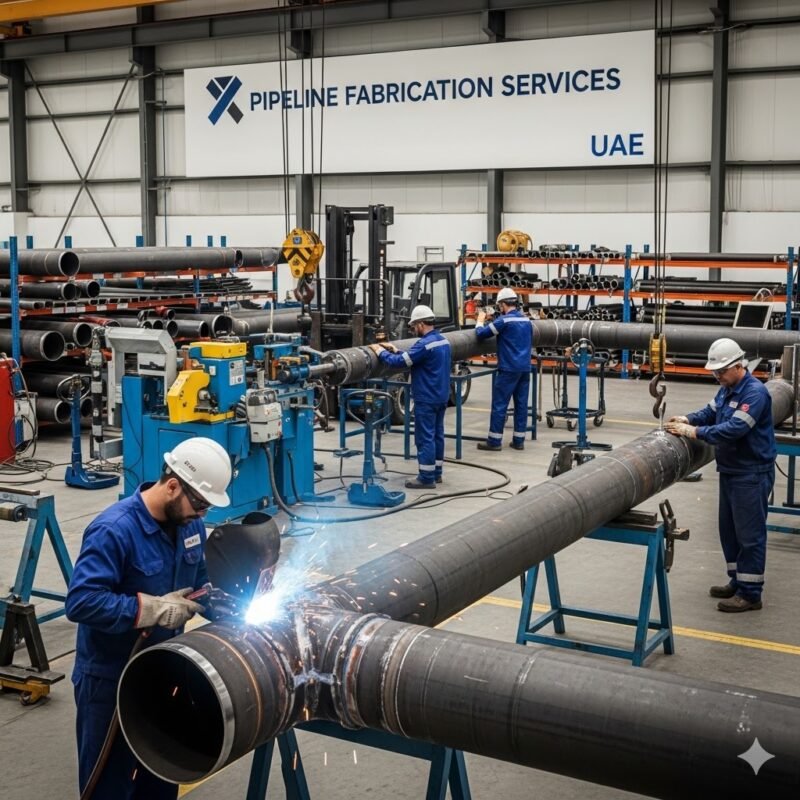
For field tie-ins and smaller bore piping, we rely on Gas Tungsten Arc Welding (GTAW/TIG) for the root pass to ensure full penetration, followed by Shielded Metal Arc Welding (SMAW/Stick) or Flux-Cored Arc Welding (FCAW) for the fill and cap passes. Our welders are masters of their craft, capable of producing defect-free welds in difficult positions.
Quality control extends beyond the welding arc. We implement a stringent Non-Destructive Testing (NDT) regime. Every butt weld in a critical pipeline undergoes 100% Radiographic Testing (RT) or Automated Ultrasonic Testing (AUT). These methods allow us to "see" inside the metal and detect microscopic flaws such as porosity, slag inclusions, or lack of fusion. We also use Magnetic Particle Inspection (MPI) to check for surface cracks on fillet welds and branch connections. Before the pipeline is commissioned, we conduct a hydrostatic pressure test. We fill the line with water and pressurize it to a level significantly higher than its operating pressure, holding it for 24 hours to prove its leak tightness and structural integrity.
Corrosion protection is the final, crucial step in Pipeline Fabrication Services UAE. The external surface of the pipe must be protected from the soil and the atmosphere. We are experienced in the application and repair of various coating systems. For buried lines, we typically encounter 3-Layer Polyethylene (3LPE) or Fusion Bonded Epoxy (FBE). While the main pipe body is coated at the mill, the field joints—where the pipes are welded together—must be coated on-site. We use specialized heat-shrink sleeves or liquid epoxy systems to protect these vulnerable areas. For above-ground lines, we apply multi-coat paint systems that resist UV radiation and sand abrasion. C&J Engineering provides the complete package: from the first cut to the final coat, ensuring your pipeline is built to last.