

Custom Design Strategies for Reactor Vessel Fabrication UAE
The chemical and petrochemical sectors in the United Arab Emirates drive a significant portion of the national economy. At the core of these industries sits the chemical reactor. This vessel is where raw materials transform into valuable products through chemical changes. Because these processes often involve high pressures, extreme temperatures, and corrosive fluids, the quality of the vessel is vital. Reactor Vessel Fabrication UAE is a specialized field that demands more than just metalworking skills. It requires a deep understanding of thermodynamics, fluid mechanics, and material science. At C&J Engineering, we apply this knowledge to build safe and efficient reactors for our clients in Abu Dhabi and beyond.
A reactor vessel is complex. Unlike a simple storage tank, it must manage energy. Chemical reactions often release heat (exothermic) or require heat (endothermic). To control this, we design reactors with heat transfer surfaces. These might take the form of an external jacket, internal coils, or a "limpet coil" welded to the outside of the shell. We calculate the surface area required to keep the reaction stable. If the vessel gets too hot, the product might spoil, or the pressure might rise to unsafe levels. If it gets too cold, the reaction might stop. We balance these factors during the design phase to ensure consistent performance.
Agitation is another critical design element. A reactor usually includes a motor-driven mixer to blend the ingredients. The design of the impeller—the blade that moves the fluid—depends on the viscosity of the liquid. A simple propeller works for water-like fluids, but thick polymers require heavy-duty anchor or helical ribbon agitators. We also install "baffles" inside the vessel. These metal strips break the swirling flow of the liquid, converting rotational energy into vertical mixing. This ensures that every part of the mixture reacts at the same rate. Our engineering team selects the motor, gearbox, and seal system to handle the torque and prevent leaks.
We also consider the materials of construction. Standard carbon steel is rarely suitable for the inside of a reactor. Most chemical processes require stainless steel, such as grade 304 or 316L, to prevent contamination and corrosion. For highly aggressive acids or high-temperature applications, we use exotic alloys like Hastelloy, Inconel, or Duplex stainless steel. We source these materials from reputable mills to ensure they meet the chemical composition required for your process. We verify the material certificates before we cut a single piece of plate. This traceability is a standard part of our Reactor Vessel Fabrication UAE process.
Advanced Manufacturing Protocols for Chemical Reactors
The fabrication of a reactor vessel takes place in our controlled workshop environment in the Mussafah Industrial Area. This allows us to maintain strict quality standards that are difficult to achieve on a construction site. The process begins with the forming of the shell and heads. We roll heavy steel plates into cylinders and press the end caps into curved shapes. The fit-up between these parts must be perfect. Any gap or misalignment can create a weak point in the weld. Our fitters use precision jigs to align the joints before welding begins.
Welding is the most critical step in Reactor Vessel Fabrication UAE. We employ certified welders who specialize in the Gas Tungsten Arc Welding (GTAW) process, often called TIG welding. This method produces high-quality, clean welds that are essential for pressure vessels. We control the heat input carefully to prevent warping of the metal. For the internal surfaces, we ensure the weld is smooth and flush with the base metal. Crevices or rough spots can trap bacteria in pharmaceutical reactors or cause polymer buildup in chemical plants. We often polish the internal welds to a mirror finish to aid cleaning and sterilization.
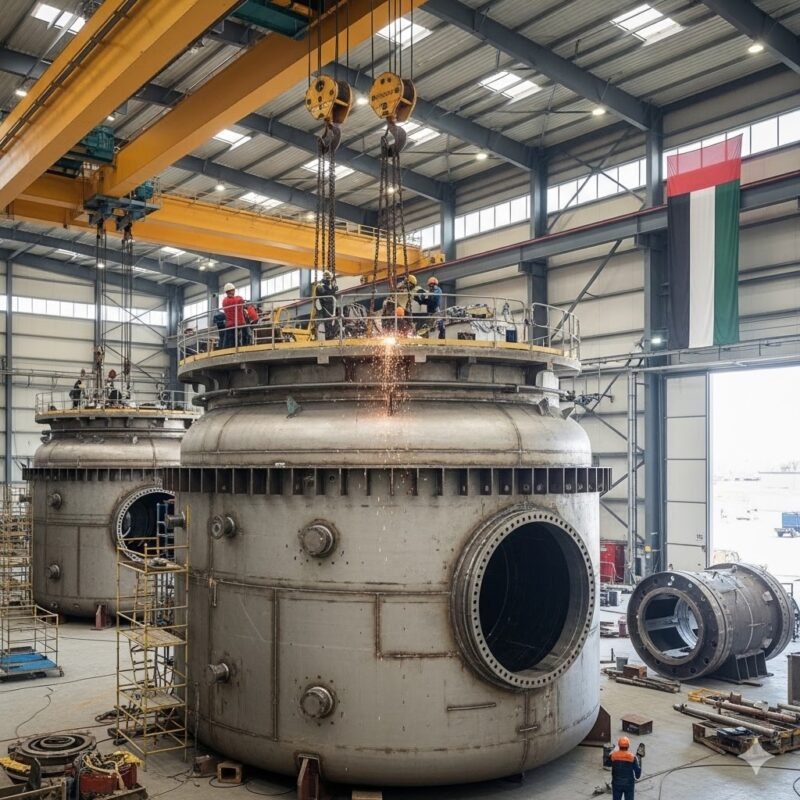
We adhere to the ASME Boiler and Pressure Vessel Code (Section VIII) for all our reactor projects. This code sets the rules for design, fabrication, and inspection. We perform Non-Destructive Testing (NDT) on the welds to verify their integrity. Radiography (X-ray) allows us to see through the metal and detect internal defects like porosity or lack of fusion. We also use dye penetrant testing to check for surface cracks. Once the fabrication is complete, we perform a hydrostatic pressure test. We fill the reactor with water and pressurize it above its operating limit. This test proves that the vessel is safe and leak-free.
Safety features are integral to the final assembly. We install pressure relief valves to vent excess pressure in case of a runaway reaction. We also include rupture discs as a secondary safety measure. We mount temperature and pressure sensors directly onto the vessel shell or through nozzle connections. These instruments send data to your control system, allowing you to monitor the reaction in real time. We design the support structure—whether legs, lugs, or a skirt—to handle the full weight of the vessel, the fluid, and the mixer.
The exterior finish of the reactor matters as well. In the humid, salty air of the UAE, external corrosion is a constant threat. We apply durable industrial coatings to carbon steel components. For stainless steel vessels, we perform "pickling and passivation." This chemical treatment removes iron contaminants from the surface and promotes the formation of a protective oxide layer. C&J Engineering delivers a complete, tested package. We understand that a reactor is the heart of your production line. We build it to last, to perform, and to keep your operation safe. We invite you to visit our facility to see our fabrication capabilities firsthand.